
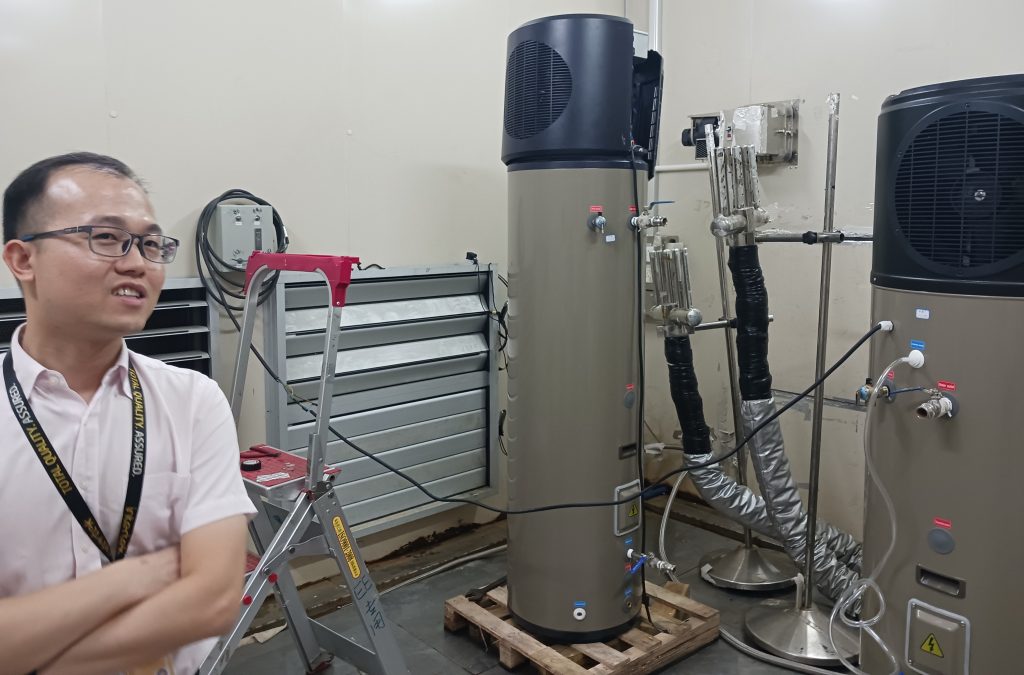
AS/NZS 5125.1:2014 outlines the method for determining the performance characteristics of air-source heat pump water heaters. It plays a critical role in the evaluation and compliance of heat pumps under Australia and New Zealand’s energy efficiency frameworks. The results of AS/NZS 5125.1 testing feed directly into modelling, in accordance with AS/NZS 4234.
Performance Testing Approach
AS/NZS 5125.1 sets out standardised testing procedures and covers both stand-alone systems (where the heat pump is separate from the tank) and integral units (where the condenser wraps around the tank) under 700L in size.
Key outputs from the AS/NZS 5125.1 test include:
- Thermal capacity – how much heat (kW) is delivered to the tank.
- Power – how much power (kW) is used by the compressor and auxiliaries
- Coefficient of performance (COP) – the ratio of useful heat output to electrical input.
Full heat up cycles at different ambient air and water temperatures are performed in environmentally controlled chambers. Additionally, a low-temperature performance test is performed and used to characterise the performance of the system in conditions when frost buildup on the evaporator is likely to be an issue.
Link Between AS/NZS 5125.1 and AS/NZS 4234
The results from AS/NZS 5125.1 testing are used to train a regression model, which estimates the unit’s COP and input power consumption, which feeds directly into the transient simulation models required by AS/NZS 4234. The low-temperature performance test contributes to adjustments in efficiency within the model to account for frosting effects in cold conditions.
Without AS/NZS 5125.1 testing, products under 700 L in size could not be modelled under the AS/NZS 4234 framework.
Design and Compliance Implications
Understanding AS/NZS 5125.1 is an important part of designing heat pump water heaters for the Australian market. Systems that perform poorly under these test conditions, especially during low-temperature testing or at temperatures relevant to rebate calculations, may receive low annual efficiency ratings. They may also fail to meet minimum hot water delivery temperatures or qualify for reduced federal/state incentives.
How EnergyAE Can Help
EnergyAE supports manufacturers and suppliers by connecting them with laboratories that carry out AS/NZS 5125.1 testing. We can assist with R&D by helping prepare models for testing, interpret results, and carry out the AS/NZS 4234 modelling. This end-to-end support helps ensure your system is tested smoothly and that the results meet or even exceed your expectations.
