
Registering Commercial HPWHs for VEU (VEECs) and ESS (ESCs): The Five Step Guide
The Victorian Energy Upgrades (VEU) and the NSW Energy Savings Scheme (ESS) both pay for commercial heat pump water heating. VEU pays through Activity 44, set out in Part 44 of the VEU Specifications, and issues VEECs. ESS pays through the IHEAB method and issues ESCs. Both are deemed schemes, so a system is modelled once, registered once, and every installation of that registered system then creates certificates.
Registration is per system configuration, not per heat pump model. The heat pump, the tanks, the plumbing arrangement, the booster element and the control settings all sit inside the registered product. Two systems built from the same heat pump can earn very different certificate counts.
This guide sets out the path from a product idea to a listing on both registers in five steps.
The five step protocol
Design
Define the system range and check it against the scheme eligibility floors before spending anything.
You hold: a defined list of configurations worth registering.Test
EN 14511 performance testing of the heat pump, plus tank heat loss testing where the tanks are small.
You hold: signed, stamped final test reports.Model
AS/NZS 4234 simulation of the whole system, to find the Commercial Peak Load and the certificate quantities.
You hold: an AS/NZS 4234 report and certificate counts per climate zone.Certify
Product certification and safety evidence. How much applies depends on tank size.
You hold: the certification and declarations each scheme asks for.Register
Lodge the VEU and ESS applications, answer requests for information, and get listed.
You hold: a listing on both registers.Steps 1 to 3 run in sequence, because each one needs the output of the one before it. Step 4 runs alongside steps 2 and 3, and it is usually the step that decides whether the project lands on time.
| # | Step | Who does it | Typical duration |
|---|---|---|---|
| 1 | Design | You, with preliminary modelling if useful | Days to weeks, depending on how settled the range is |
| 2 | Test | A recognised test laboratory | The longest lead item. Book early |
| 3 | Model | EnergyAE | About 2 weeks for modelling and submission preparation, once documents are complete |
| 4 | Certify | Certification bodies and test laboratories, arranged by you | Runs in parallel. Electrical safety is the usual holdup |
| 5 | Register | EnergyAE lodges, ESC and IPART assess | 6 to 10 weeks for assessment |
What the two schemes pay for
The schemes are administered separately, use different equations and publish different climate zones. A single AS/NZS 4234 model serves both, so the two applications are prepared together.
| VEU (Victoria) | ESS (New South Wales) | |
|---|---|---|
| Administrator | Essential Services Commission | IPART |
| Method | Activity 44 | IHEAB |
| Certificate | VEEC | ESC |
| Climate zones published | Zone 4 (Melbourne and most of Victoria), Zone 5 (alpine and north-east Victoria) | Zone 3 (Sydney and coastal NSW), Zone 5 (tablelands and alpine areas) |
| Deemed lifetime | 15 years with a new tank, 10 years reusing the existing tank | 12 years |
| Small system factor | LoadFactor | ConfidenceFactor |
| Cap per installation | None | 5,000 ESCs per item of end-user equipment |
| Portal | VEU Registry | TESSA |
Certificates are per installation, in one climate zone. An installation sits at one site, in one AS/NZS 4234 climate zone, and creates that zone's certificates. The registers publish a figure per zone because the two are alternatives, not a total. Adding them together roughly doubles the answer.
The three activity scenarios
What a system earns depends on what it replaces. VEU splits this into three scenarios and ESS into two activities.
| Scenario | VEU | ESS | Relative certificate count |
|---|---|---|---|
| Replacing a gas water heater or boiler | 44A(i) | F16 | About half the electric replacement figure |
| Replacing electric resistance heating | 44A(ii) | F16 | The highest count of the three |
| New installation, no existing system | 44A(iii) | F17 | About a third to a half of the electric replacement figure |
Electric resistance replacement carries the full emissions factor credit and produces the largest certificate count, but large electric water heating plant is rare in the Australian commercial market, and where one is replaced the capacity factor usually reduces the result further. Most commercial projects are new installations or gas replacements, so 44A(i) and 44A(iii) are the representative scenarios, and those sit at around a third to a half of equipment cost.
What registered systems earn
These are real figures, computed from the modelling outputs each product has published on the register. They cover systems replacing electric resistance heating, in the most populous zone of each scheme, and only systems averaging 10 kW or more per heat pump.
| Total heat pump capacity | VEECs, zone 4 (median) | ESCs, zone 3 (median) |
|---|---|---|
| 30 to 75 kW | 988 | 2,081 |
| 75 to 150 kW | 2,049 | 4,251 |
| 150 kW and above | 3,223 | 5,000 (at the cap) |
NSW issues roughly twice the certificate count, but a VEEC trades higher than an ESC, so a Victorian installation is currently worth around 1.4 times a NSW one. Every registered system above 150 kW hits the NSW cap of 5,000 certificates.
For a figure against your own capacity, tank volume and refrigerant, use the commercial incentive estimator.
Step 1. Design
What counts as one configuration
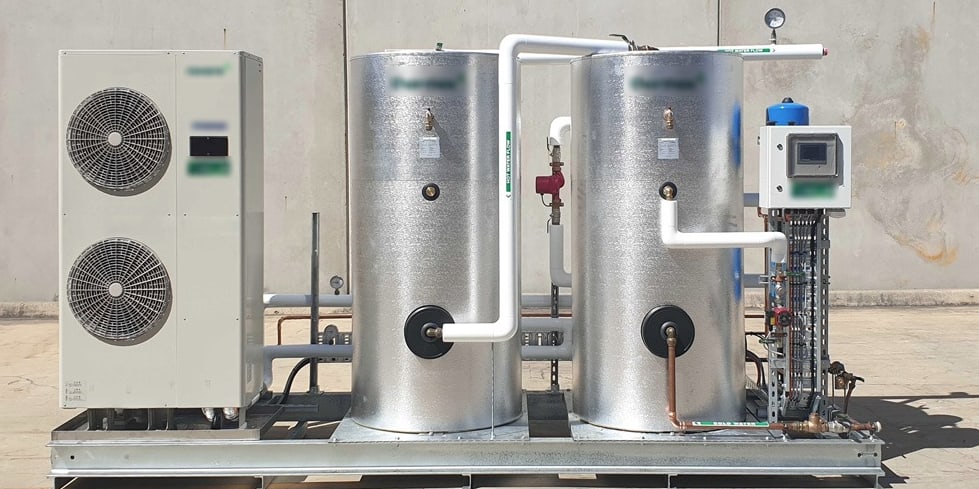
Everything inside the dashed boundary below forms one registered product. Change any numbered element and you have a second configuration to model and register.
| # | Element | What defines it in the submission |
|---|---|---|
| 1 | Heat pump units | Model name and how many, matched exactly to the EN 14511 report and the data plate |
| 2 | Pump and flow control | Fixed flow rate, fixed outlet temperature, or fixed temperature rise, with the pump power curve |
| 3 | Pipework | Insulation thickness in mm and thermal conductivity in W/mK, for flow and return |
| 4 | Storage tanks | Model, quantity, volume, and whether they are single, parallel or in series |
| 5 | Control sensors | Sensor position and volume, set point, dead band, and the legionella cycle |
| 6 | Booster element | None, one, or two, with set point and dead band |
| 7 | Load | The Commercial Peak Load the modelling finds the system can serve |
The design variables the templates cover
Each configuration is modelled from a simulation template matched to how the system is plumbed and controlled. Most commercial systems fall inside the following set.
| Variable | Options covered |
|---|---|
| Tank arrangement | A single tank, a parallel tank bank, or two to six tanks in series |
| Flow control | Fixed flow rate, fixed outlet temperature, or fixed temperature rise across the heat pump |
| Heat exchange | Direct tank heating, a heat pump coil in the tank, a load-side coil, a split coil, or an integral unit |
| Temperature control | Single sensor or two sensor |
| Booster elements | None, one, or two |
| Set point strategy | A fixed year-round set point, or set points varied by month or season |
| Sanitisation cycle | None, daily, or weekly |
| Test data | EN 14511 or AS/NZS 5125.1 |
A system arranged outside this set needs a new template built and validated before its configurations can be modelled.
The eligibility floors
Through 2025 and 2026 both schemes were tightened to aim the incentive at engineered, larger scale plant. Four rules decide whether a design is worth registering at all, and they turn on averages rather than totals.
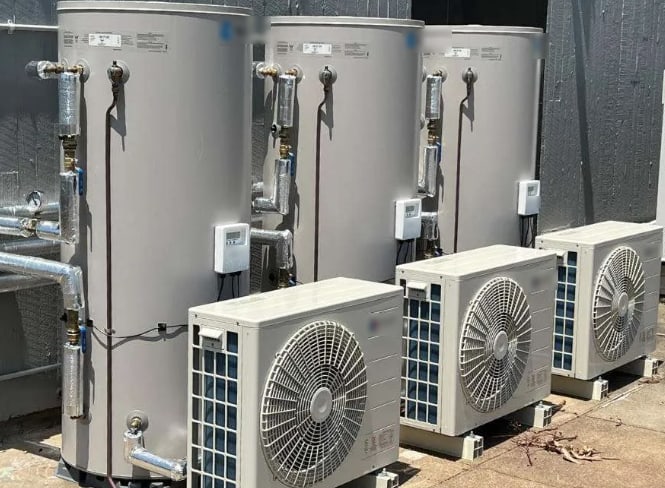
- Average storage volume, VEU only. VEU asks for 700 L, or between 425 L and 700 L where average heat pump capacity is above 20 kW. Average storage below 425 L is not eligible for commercial VEECs at all. NSW has no equivalent floor.
- Average heat pump capacity. Below 10 kW average, both schemes cut the certificate count hard. Average capacity is total heat pump thermal capacity divided by the number of heat pumps, so four 5 kW units are a small system even though they total 20 kW. Reading the threshold off the system total is the specific mistake the rule exists to catch.
- The VEU LoadFactor. Below 10 kW average, VEECs are multiplied by 42 × N ÷ Commercial Peak Load, capped at 1, where N is the number of heat pumps. It applies to all three 44A scenarios. On the register today it runs as low as 0.11, so a system can earn a ninth of what its modelling alone would suggest.
- The ESS ConfidenceFactor. Same trigger, different formula: 42 ÷ Peak Load, with no N. Because the heat pump count drops out, it cuts a multi heat pump system several times harder than the VEU version.
Most of the register sits below these floors. Of 346 systems on the VEU Activity 44 register, 274 average under 10 kW per heat pump. The common pattern is three to six small heat pumps manifolded onto one tank, which is the arrangement the 2025 rule changes were aimed at.
Preliminary modelling
Preliminary modelling runs an indicative AS/NZS 4234 simulation from data you already hold: internal or catalogue heat pump performance, a tank drawing or schematic, and your control logic. It shows how the system performs and roughly where the certificate numbers land, before you commit to laboratory testing.
It cannot be lodged with a scheme. Certificate earning results require EN 14511 data from a recognised laboratory. Its value is that it answers the go or no-go question for a few thousand dollars rather than the cost of a test round.
Step 2. Test
EN 14511 performance testing
EN 14511 is a European standard, and in these schemes it is used for one specific purpose: to build a heat pump performance map that feeds the annual AS/NZS 4234 simulation. The map defines how the heat pump performs across combinations of air temperature and water inlet temperature.
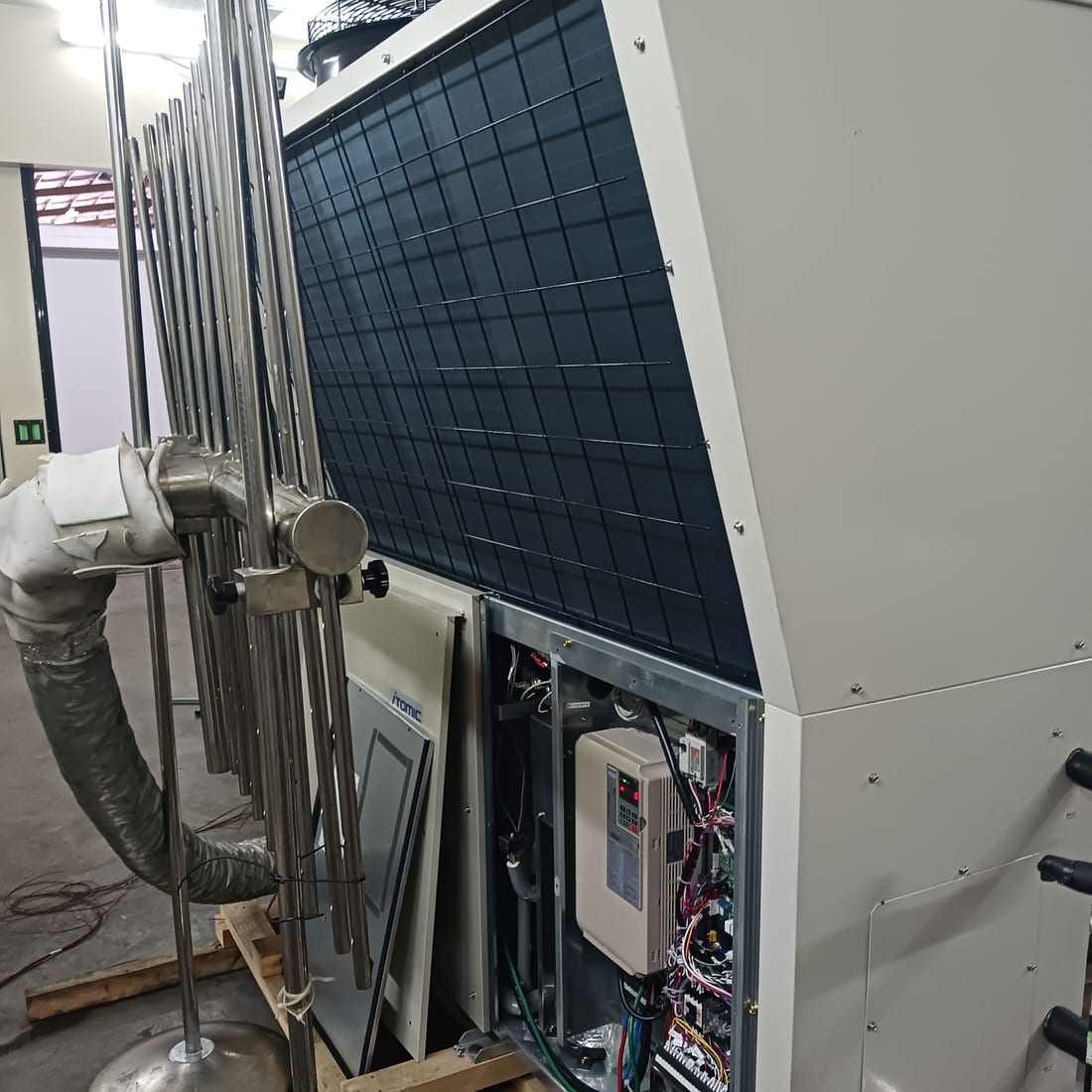
Twelve test conditions are the usual requirement. The minimum the regulators accept is the maximum inlet water temperature expected in normal operation, plus at least one of the required air points. The required air points are 2°C/1°C, 7°C/6°C, 12°C/11°C or 19°C/15°C, given as dry bulb over wet bulb. Results are linearly extrapolated down to a dry bulb of -5°C, so there is no need to test at -5°C.
These baseline matrices are starting points rather than universal requirements:
| Refrigerant | Water inlet temperatures | Air temperatures (dry bulb/wet bulb) |
|---|---|---|
| R-290 | 10°C, 50°C, 70°C | 2°C/1°C, 7°C/6°C, 19°C/15°C, 38°C/25°C |
| CO2 | 10°C, 30°C, 50°C | 2°C/1°C, 7°C/6°C, 19°C/15°C, 38°C/25°C |
The upper water inlet point should sit just below the system’s maximum rated water temperature. For an R-290 unit with a 75°C tank set point and a 5 K rise, that is 70°C. For a CO2 unit with a 90°C outlet that shuts the compressor off above 50°C inlet, it is 50°C. Adding a hot air point between 30°C and 38°C usually improves the modelled result, because capacity and COP are higher in warm ambient conditions and much of Australia operates there.
For the full treatment, see how to select EN 14511 test conditions.
In-house testing before the accredited round
In-house EN 14511 testing is useful early, to check whether the minimum performance requirement is likely to be met. Both schemes require at least 60% annual energy savings against the AS/NZS 4234 reference system, which corresponds to an annual system COP of roughly 2.5. A design that cannot reach that in-house will not reach it in an accredited laboratory.
For the application itself, third party NATA accredited or equivalent testing is required. This is currently available through Intertek China, CVC and Yukawa Laboratory.
A draft or unsigned report cannot be lodged with either scheme. Getting a final, stamped report with a validity confirmation from the laboratory before modelling starts is the single cheapest thing you can do to keep a project on schedule.
Tank testing
Where the tanks are 700 L or less, an AS/NZS 4692.1 standing heat loss test report from an accredited laboratory is required. Above 700 L, heat loss is calculated from the drawing geometry under AS/NZS 4234 Appendix E instead, and no tank heat loss test is needed.
The tank drawing then has to state internal diameter, internal height, total internal volume, insulation thickness on wall, top and bottom, insulation material or thermal conductivity, and the height of every connection.
Step 3. Model
The AS/NZS 4234 model is a TRNSYS simulation of the whole system across a full year, in each climate zone the schemes publish. It takes the performance map from step 2 together with the physical and control description of the system, and produces the numbers the application rests on.
- Performance mapThe EN 14511 grid is normalised into a map the simulation can interpolate across, and extrapolated down to a dry bulb of -5°C.
- System modelTank geometry, heat loss, pipework, pump, sensors, set points, dead bands and the sanitisation cycle are assembled into the template that matches your arrangement.
- Commercial Peak LoadThe load is increased until the system reaches its limit. The Commercial Peak Load is the largest load it can serve while still meeting minimum delivery temperature and the savings threshold.
- Annual energy savingsModelled annual energy use against the AS/NZS 4234 reference system. Below 60%, the activity cannot be claimed at all.
- Certificate quantitiesThe scheme equations convert the modelled outputs into VEECs and ESCs, per climate zone, for each activity scenario.
Minimum delivery temperature is usually the governing criterion rather than energy savings. AS/NZS 4234 requires delivered water at 45°C through the peak draw.
The performance map is fixed once the unit has been tested, but control settings are not, and they can be swept against the real test data right up until submission. Set points, dead bands, sensor position and volume, storage capacity, booster behaviour, tank plumbing arrangement and insulation thickness all move the result. Two registered systems of the same rated capacity earn certificate counts up to twice apart, and that gap is set by these choices.
EnergyAE confirms the Commercial Peak Load and the modelling results with you before certificate quantities are finalised, so the numbers the registration rests on are approved before anything is lodged. For more on how the results become certificates, see how commercial HPWH results become VEU and ESS certificates.
Step 4. Certify
Product certification is separate from the scheme certificates, and it is where the schedule usually slips. How much of it applies turns on one number: 700 L.
Full certification track
- AS/NZS 2712 design and construction certificate, listing the applied brand and model
- AS/NZS 4692.1 tank heat loss test report
- Electrical safety certificate and ERAC or EESS registration
- Minimum 5-year warranty against defects, with the Australian Consumer Law paragraph reproduced word for word
Reduced track
- No AS/NZS 2712 certificate required
- No AS/NZS 4692.1 test. Heat loss is computed from the drawing under AS/NZS 4234 Appendix E
- No scheme electrical safety requirement
- No scheme warranty condition, though the Australian Consumer Law still covers the sale
The VEU warranty condition has applied since 31 March 2025 to systems with insulated storage of 700 L or less, and the ESS equivalent since 1 December 2025. The warranty text can sit inside the installation manual rather than in a standalone document, provided it carries the five year term, Australian contact details for claims, what the consumer must do to claim and who bears the cost, and the mandatory Australian Consumer Law paragraph unaltered.
Start electrical safety early. Electrical safety testing and certification is the most common holdup on VEU and ESS applications, and the AS/NZS 2712 certificate depends on it. Treat it as a step 1 decision rather than a formality at the end.
WaterMark is a separate track. WaterMark certification under AS/NZS 4020 and AS/NZS 3498 is a plumbing and installation requirement. It is not required by SRES, VEU or ESS, and it is not part of scheme registration.
Step 5. Register
Both applications can be lodged in parallel, and one set of modelling and documentation covers them both. Portal accounts should be set up before the pack is ready. See setting up VEU and TESSA portal accounts.
- Confirm the exact model names that will appear in the public listings. They must match across the test report, data plates, drawing, schematic, manual and declarations. Name mismatches are the most common cause of rework.
- Lodge the VEU application through the VEU Registry, against the ESC’s Commercial and Industrial Air Source Heat Pump Water Heater Product Application Guide. A step by step walkthrough is in how to submit a HPWH application through the VEU Registry.
- Lodge the ESS application through TESSA under the IHEAB method. See how to submit a commercial HPWH through TESSA.
- Answer requests for information. VEU and ESS assess each application individually, so an RFI here costs more than the equivalent under SRES. Each one realistically adds weeks.
- Get listed, then install. Approval typically takes 6 to 10 weeks where the documentation is complete and consistent.
Under VEU Activity 44 a product only has to be on the Register of Products by the time VEECs are created, not by the installation date, so installing while an application is still under assessment is technically possible. It is not worth doing. There is no guaranteed approval timeframe, and if the ESC comes back requiring changes to the model, an already installed system may not qualify as modelled.
VEECs are not backdated to the lodgement or publication date. They are eligible from the date the installation was completed, and they must be created no later than six months after the end of the year in which the activity occurred. A 2025 installation needs its VEECs created by 30 June 2026.
Documents to have ready
Model names must be consistent across every document. Send everything as searchable PDFs or clear images.
| Step | Document | Notes |
|---|---|---|
| 2 | EN 14511 test report | Signed and stamped, with laboratory validity confirmation |
| 2 | AS/NZS 4692.1 heat loss report | Tanks 700 L or less only |
| 1, 3 | Tank drawing | Dimensioned, with a data table: internal diameter, volume, wall thickness, thermal conductivity, port and sensor heights, coil geometry, insulation spec |
| 1, 3 | System schematic | Heat pump, tank and pump brand and model, flow path, control valves, sensor locations, legible title block |
| 3 | Pipe insulation specification | Thickness in mm and thermal conductivity in W/mK, inlet and outlet |
| 3 | Pump power curve | Flow rate in L/min against power consumption in W |
| 3, 5 | Bill of materials | Components and quantities, for verification against the schematic |
| 3 | Control declaration | Signed statement of set point, dead band, outlet target, sensor position and volume, legionella method and frequency, long shutdown behaviour |
| 4 | AS/NZS 2712 certificate | Tanks 700 L or less only |
| 4 | Electrical safety evidence | ERAC or EESS registration and the electrical safety certificate |
| 5 | Data plates | Photos or PDFs. The heat pump model must match the EN 14511 report exactly |
| 5 | Installation manual | Brand and model names, plumbing schematic, control strategy, warranty text, legionella control consistent with the control declaration |
| 5 | Applicant company details | Legal name, ABN, address and contact for the scheme forms |
| 5 | Authorisation letter | Where the report owning company differs from the applicant: permission to use the test reports, listing all third party report numbers, signed |
The full version, with what each document has to show, is in the commercial HPWH documentation checklist.
Common causes of delay
- Model names that do not match across the test report, data plate, drawing, schematic and manual.
- Draft or unsigned test reports, which cannot be lodged and send the project back to the laboratory.
- Electrical safety certification started late, which then holds up the AS/NZS 2712 certificate, which then holds up the application.
- A test matrix that is too narrow, so the performance map does not cover the water inlet temperatures the system actually operates at.
- System definition changing after modelling: a different heat pump count, a different tank model, or control settings in the manual that contradict the control declaration.
- A layout outside the template set, found after testing rather than during design.
Common questions
Can EN 14825 data be used instead of EN 14511?
No. EN 14825 is a seasonal efficiency standard used for ERP labelling, and it tests at part-load seasonal conditions. VEU Activity 44 and ESS IHEAB need the steady-state operating points that build the AS/NZS 4234 performance map, which is what EN 14511 produces. An EN 14825 report cannot substitute for it.
How many EN 14511 test points are needed, and at what conditions?
Twelve conditions is the usual requirement: air dry bulb points at 2°C, 7°C, 19°C and 38°C, each run across three water inlet temperatures. The minimum the regulators accept is the maximum inlet water temperature expected in normal operation plus at least one of the required air points (2°C/1°C, 7°C/6°C, 12°C/11°C or 19°C/15°C, dry bulb over wet bulb).
Set the upper water inlet point just below the system's maximum rated water temperature. Results are linearly extrapolated down to a dry bulb of -5°C, so there is no need to test there.
Do VEEC and ESC quantities fall year on year?
No. Neither scheme has an automatic annual step-down. The VEU emissions factor was on a declining trajectory that finished on 1 February 2025, and the ESS deemed life is already built into the method. A count quoted today holds for installations today.
Policy changes are a different matter, and they do move the numbers. The 2025 Activity 44 changes and IPART's August 2025 confidence factor both cut certificate quantities materially, and two scheme reviews are open that could affect 2027. Check the ESS rule and changes page for the current NSW rule version before relying on an old calculator.
Can VEEC claims be backdated, and what date do they count from?
VEECs are not backdated to the lodgement or publication date. They are eligible from the date the activity, meaning the installation, was completed.
They must be created no later than six months after the end of the year in which the activity occurred, so a 2025 installation needs its VEECs created by 30 June 2026.
Can a system be installed before registration comes through?
Technically yes under VEU Activity 44, because a product only has to be on the Register of Products by the time VEECs are created, not by the installation date. EnergyAE does not recommend it.
The Essential Services Commission's own process puts product approval before installation. There is no guaranteed approval timeframe, and if the assessment comes back requiring changes to the model, an already installed system may not qualify as modelled. Treat approval as the gate before committing to an install date.
Are small systems eligible?
Eligible, but heavily discounted. Average heat pump capacity below 10 kW triggers the VEU LoadFactor and the ESS ConfidenceFactor, and on the register today the VEU version runs as low as 0.11. Under VEU, average storage below 425 L is not eligible for commercial VEECs at all, and 700 L is the standard requirement (425 L to 700 L is allowed where average heat pump capacity is above 20 kW).
Average capacity is the system total divided by the number of heat pumps, so four 5 kW units are a small system. Reading the threshold off the total is the specific mistake the rule exists to catch.
How long does the whole process take?
Modelling and submission preparation is about two weeks once the documents are complete. VEU and ESS assessment then typically takes 6 to 10 weeks. Testing sits ahead of both and is the longest lead item.
Follow-up applications for additional variants tend to run faster once assessors are familiar with the system, but there is no official fast track. Every package carries its own modelled capacity and load figures and is assessed independently, even where the heat pump has been approved before under a different package.
Can preliminary performance data be used for modelling?
For a go or no-go decision, yes. Preliminary modelling runs on manufacturer COP, capacity and power data and shows roughly where the certificate numbers land before you commit to testing.
It cannot be lodged. The registered certificate calculation needs EN 14511 data from a recognised laboratory, and preliminary results are subject to change once real test data arrives.
Is electrical safety registration required?
Only for systems with insulated storage of 700 L or less. Above that, neither scheme imposes an electrical safety requirement. Where it does apply, it is the most common cause of a late application, because the AS/NZS 2712 certificate depends on it.
Is a separate warranty document required?
A warranty is required for systems with tanks of 700 L or less, but a standalone document is not. The text can sit inside the installation manual, provided it carries the five year term, Australian contact details for claims, what the consumer must do to claim and who bears the cost, and the mandatory Australian Consumer Law paragraph reproduced word for word.
Can the VEU and ESS applications be lodged at the same time?
Yes, and they normally are. One set of modelling and documentation covers both, and the two assessments run independently. Approval in one state has no effect on the other, and neither administrator forwards anything to the other.
What happens if an application is rejected or comes back for revision?
Both schemes assess applications individually, so a request for information here costs more than the equivalent under SRES. Each round realistically adds weeks, and an application left unanswered can be withdrawn automatically.
Most requests turn on document consistency rather than performance: a model name that differs between the test report and the data plate, control settings in the manual that contradict the control declaration, or a test report without a verifiable signature. All of those are cheaper to fix before lodgement than after.
Next steps
If you are developing a commercial HPWH system and want to know how it will perform under the VEU or ESS methodology, get in touch with the heat pump model, tank sizes and control logic you have.