
For commercial & industrial manufacturers
The certificate schemes pay for a large share of a commercial heat pump
In Victoria (VEU Activity 44) and NSW (ESS Schedule F), a commercial heat pump water heater built from units of 10 kW or more earns deemed certificates worth tens to hundreds of thousands of dollars, especially when it replaces electric. The figures below are what systems currently on both registers actually earn.
How the VEU and ESS schemes work for commercial heat pumps
Both are deemed-savings schemes: a product is modelled once, registered, and then every installation creates tradeable certificates that offset the system cost. The schemes target the emissions displaced, so the business case is strongest where a heat pump replaces electric resistance heating.
Replacing electric pays most
Decommissioning electric resistance heating carries the full emissions-factor credit, so it earns the highest certificate count. On the registered systems it runs about 2 to 2.5 times a gas replacement of the same size.
Two markets, one model
A product modelled once under AS/NZS 4234 can register for both VEU (VIC, VEECs) and ESS (NSW, ESCs). NSW issues roughly twice the certificate count, but a VEEC currently trades near $85 against $30 for an ESC, so a Victorian installation is worth around 1.4 times a NSW one.
Design captures the upside
Two systems of the same rated capacity earn certificate counts up to twice apart on the register today, set by control logic, setpoints and the COP curve. Good modelling captures the top of that range.
Small systems have largely been designed out of both schemes
Small means average heat pump capacity below 10 kW, or average storage below 425 L. Average capacity is total heat pump capacity divided by the number of heat pumps, so four 5 kW units are a small system even though they add up to 20 kW. That is the case the 2025 rule changes were aimed at, and 274 of the 346 systems on the VEU register fall into it.
- Storage. Average storage below 425 L is not eligible for commercial VEECs at all. VEU asks for 700 L, or 425 L to 700 L where average heat pump capacity is above 20 kW. NSW has no equivalent floor.
- Victoria, the LoadFactor. Below 10 kW average, certificates are multiplied by 42 × N ÷ Commercial Peak Load, capped at 1, where N is the number of heat pumps. It applies to all three 44A activities. On the register today it runs as low as 0.11, so a system can earn a ninth of what its modelling alone would suggest.
- New South Wales, the ConfidenceFactor. Same trigger, but the formula is 42 ÷ Peak Load with no N, so it cuts a multi-heat-pump system several times harder than the VEU version. NSW also caps any one installation at 5,000 certificates per item of equipment, and heat pumps joined by manifold count as one item.
Typical certificate values, replacing electric
What commercial heat pump water heaters currently on the two registers actually earn, by total capacity band. Computed from each product's own registered modelling outputs, so every figure here is one you can look up. One installation sits in one AS/NZS 4234 climate zone and creates that zone's certificates, so these are zone 4, Melbourne and most of Victoriazone 3, Sydney and coastal NSW. Only systems averaging 10 kW or more per heat pump are counted, which is where neither scheme's small-system factor applies. See the note above for what happens below that.
| Capacity | VEEC median | Range (P10–P90) | ≈ value | Systems |
|---|---|---|---|---|
| 30–75 kW | 9882,081 | 793–1,3021,770–2,907 | $84k$62k | 2417 |
| 75–150 kW | 2,0494,251 | 1,615–2,7503,360–5,000 | $174k$128k | 3225 |
| 150 kW+ | 3,2235,000at the 5,000 cap | 2,364–3,736all 11 at the cap | $274k$150k | 1111 |
Dollar figures at $85/VEEC. VEU Activity 44A(ii), register snapshot 2026-08-30.Dollar figures at $30/ESC. ESS Activity F16 electric, register snapshot 2026-08-30. Gas replacement and new installations earn less, roughly 35 to 50% of the electric-replace figures. Every registered system above 150 kW hits the 5,000 certificate limit in ESS clause 9.9.5, and 5 of the 25 systems between 75 and 150 kW hit it as well, which is why those figures stop there. Your own certificate quantity comes from full AS/NZS 4234 TRNSYS modelling of your specific system, not from this table.
Get your own numbers
One tool predicts a typical range for a system you describe. The other two show every commercial heat pump water heater already registered, and exactly what it earns. All three are free and live on the public registers.
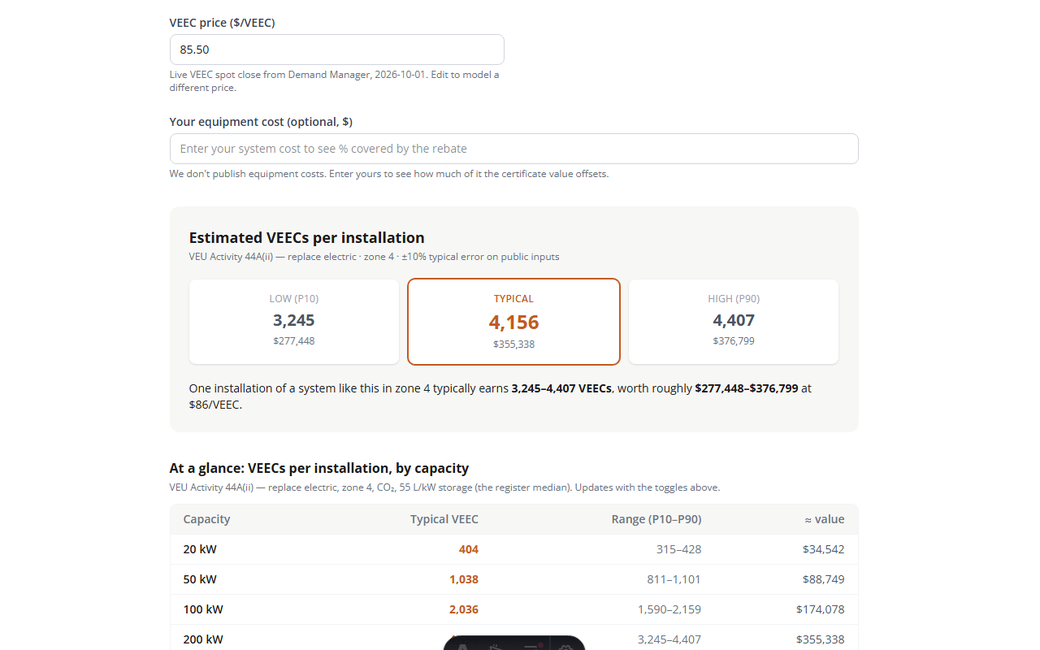
Commercial incentive estimator
Don't know your exact numbers yet? Enter a capacity, tank volume and refrigerant and get a typical VEEC or ESC range in seconds, from a model trained on 180,000 AS/NZS 4234 simulations.
Open the estimator →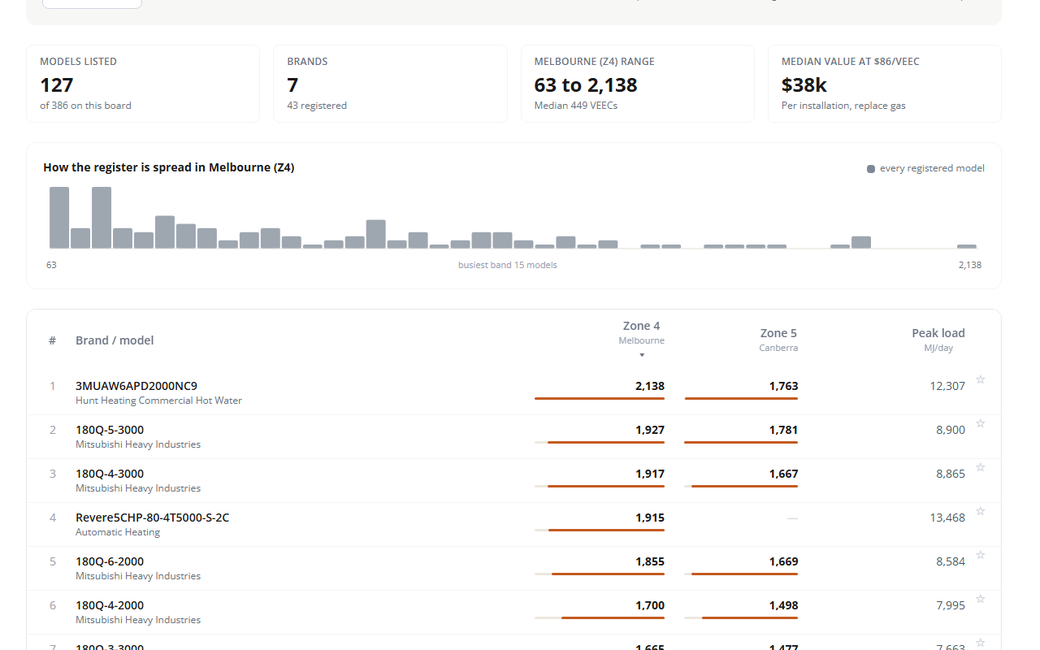
VEU commercial certificate board
Every commercial heat pump water heater on the VEU Register of Products, with the VEECs it creates under Activity 44A(i), 44A(ii) and 44A(iii), including the refrigerant credit.
Browse the VEU register →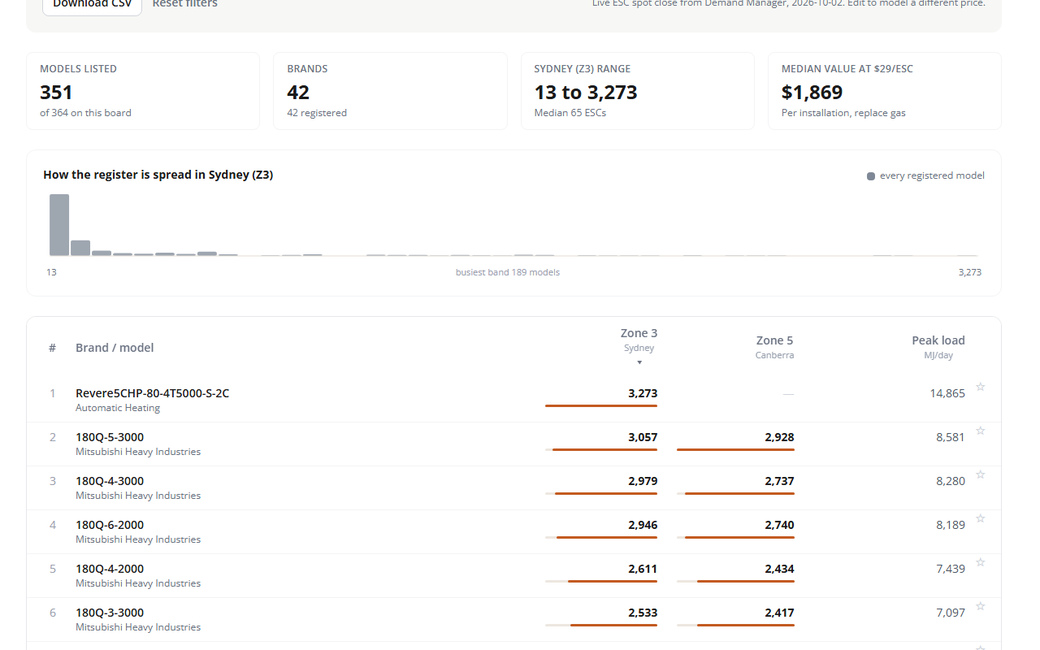
ESS commercial certificate board
Every commercial heat pump water heater on the NSW ESS registry, with the ESCs it creates under Activity F16 (replace gas or electric) and F17 (new install).
Browse the ESS register →The EnergyAE method
Five steps from product to certificates
The same five steps run on every heat pump water heater we take to the schemes. Each one uses the output of the step before it, so running them out of order means doing the work twice. Below is what each step covers for a commercial system, and the design step is the one that matters most, because a refrigerant, a storage split or a sensor position sets a ceiling the other four cannot lift.
Design
Topology, refrigerant, capacity and storage split, control setpoints and sensor positions. Storage volume and heat pump capacity also decide eligibility outright, so this step sets a ceiling the other four cannot lift.
Test
EN 14511 third-party testing builds the heat pump performance map, plus AS/NZS 4692.1 tank heat loss for tanks up to 700 L. The test matrix is chosen before the lab starts, because it bounds what the model can show.
Model
AS/NZS 4234 annual simulation in TRNSYS finds the Commercial Peak Load per climate zone, which is the quantity both schemes pay on. VEU covers zones 4 and 5, ESS covers zones 3 and 5.
Certify
For tanks up to 700 L: AS/NZS 2712, electrical certification on EESS, and warranty evidence to Australian Consumer Law wording. Above 700 L most of that falls away, which is why the certification load on a large commercial system is lighter than on a residential one.
Register
Applications lodged and tracked on the VEU Activity 44 and ESS IHEAB registers. Approval usually lands in 6 to 8 weeks where the document set is complete and internally consistent.
→ Every install of a registered system then creates deemed certificates, sold into the scheme market
EnergyAE runs all five steps, and we can pick the path up wherever you are now. We have modelled 177 commercial heat pump water heater systems under AS/NZS 4234, which is the experience behind this page rather than the data behind the estimator. Our guide to registering a commercial HPWH for VEU and ESS walks the same five steps in full, and our incentive schemes service covers the end-to-end offering.
Read more about the commercial schemes
Our guides cover how the VEU and ESS schemes treat commercial heat pumps in detail.
Registering commercial HPWHs for VEU and ESS
The 2026 step-by-step guide to registering a commercial heat pump for VEECs and ESCs.
Read the guide →How modelling results become certificates
How AS/NZS 4234 model outputs convert into VEEC and ESC certificate counts.
Read the guide →Commercial HPWH registration FAQ
Common questions on eligibility, capacity, refrigerants and the registration process.
Read the guide →See all technical guides.
See what your product is worth
Tell us about your system and we will talk you through what it would earn under the VEU and ESS schemes, what testing it needs, and what registration involves.