
Residential HPWH Documentation Checklist
Residential heat pump water heater registrations depend on a consistent evidence pack. The heat pump, tank, condenser, controls, certificates, manuals, data plates, and model names all need to describe the same product that will be sold in Australia or New Zealand.
EnergyAE can review partial evidence early, but AS/NZS 4234 modelling and scheme submission cannot be completed until the required test reports, drawings, control details, and certification evidence are clear.
What this applies to
This checklist applies to residential HPWH products being prepared for AS/NZS 4234 modelling, SRES registration through CER, VEU residential HPWH registration, ESS residential HPWH registration under HEER, or product comparison before submission.
It covers integral HPWHs, where the condenser is part of the tank assembly, and separate HPWH systems, where the heat pump and tank are connected by a water circuit.
Documents required
| Document | Why it is needed |
|---|---|
| AS/NZS 5125.1 test report | Provides heat pump COP, capacity, and power input data for AS/NZS 4234 modelling. |
| Raw test data | Supports regression, calculation, and quality checks on the test report. |
| AS/NZS 4692.1 tank heat loss report | Provides standing heat loss evidence for the storage tank. |
| Tank drawing | Provides tank geometry, fitting heights, element positions, sensor positions, and insulation details. |
| Condenser or heat exchanger drawing | Defines the wrap-around coil, microchannel, internal coil, or separate water circuit used to transfer heat into the tank. |
| System schematic | Shows how the heat pump, tank, pump, sensors, condenser, and pipework are arranged. |
| Installation manual | Confirms installation conditions, plumbing, control settings, warranty, and product claims. |
| Warranty evidence | Confirms a minimum 5-year warranty with Australian Consumer Law wording, required by VEU and ESS. Can sit inside the installation manual. |
| Data plate images | Confirms model names, electrical ratings, refrigerant type, refrigerant charge, and product identification. |
| AS/NZS 2712 certificate and schedule | Supports design and construction certification and confirms listed system models. |
| AS 3498 water safety certification | Supports water safety and public health certification where required for the application pathway. |
| Electrical safety certificate and EESS or RCM evidence | Supports electrical safety evidence and Australian electrical compliance. |
| Control settings or declaration | Confirms setpoints, deadbands, legionella control, boost logic, and operating modes. |
| Technical details sheet | Provides structured product details for modelling and application preparation. |
| Authorisation letter or model equivalence declaration | Explains OEM branding, model name differences, prototype testing, or use of test reports from a related model. |
Test data required
The AS/NZS 5125.1 report is the main heat pump performance input for residential HPWH modelling. It should identify the tested model, test laboratory, test conditions, water temperatures, ambient conditions, heating capacity, power input, COP, standby power where reported, and any assumptions used in the final results.
Provide the raw time-series data for the required test conditions, including low-temperature performance data where frosting behaviour matters. If the laboratory provides regression sheets, calculation sheets, or corrected data separately from the signed report, include those files as well.
The AS/NZS 4692.1 tank heat loss report should identify the tank model, storage volume, test result, test laboratory, and report date. The tank model name should match the drawing, certificate schedule, data plate, and submitted system model relationship.
Tank and condenser evidence
The tank drawing should be an engineering drawing, not a brochure image. It should state the tank model name, internal volume, internal diameter, internal height, wall thickness, insulation details where available, and the height of every inlet, outlet, element, thermostat, sensor, and heat exchanger connection above the tank base.
For integral systems, provide enough condenser detail to reproduce the heat transfer arrangement in the model. For coil condensers, include tube length, internal diameter, wall thickness, material, and top and bottom connection heights. For microchannel or wrap-around condensers, include strip length, number of strips, internal cross section where available, and position on the tank.
For separate systems, provide the pipework arrangement between the heat pump and tank, pump model or flow control method, flow direction, sensor positions, and any heat exchanger details. If the drawing does not show fitting heights or sensor positions, the model may not represent the physical product correctly.
System schematic
The schematic should show the exact system configuration being submitted, not a generic plumbing concept.
It should identify the system model, heat pump model, tank model, pump model and location, flow direction, controller, sensors, condenser or heat exchanger, electric element, valves, and any alternative configurations included in the application.
For all-in-one units, the schematic can be simple, but it still needs to show the relationship between the heat pump, condenser, tank, sensors, and element. For separate systems, it should show the full water circuit between the heat pump and storage tank.
Example drawings
The fastest way to avoid a drawing query is to match the level of detail EnergyAE needs from the start. The examples below show what a compliant drawing looks like for each part of the system. You are welcome to pass these to your factory or drafter as a format guide.
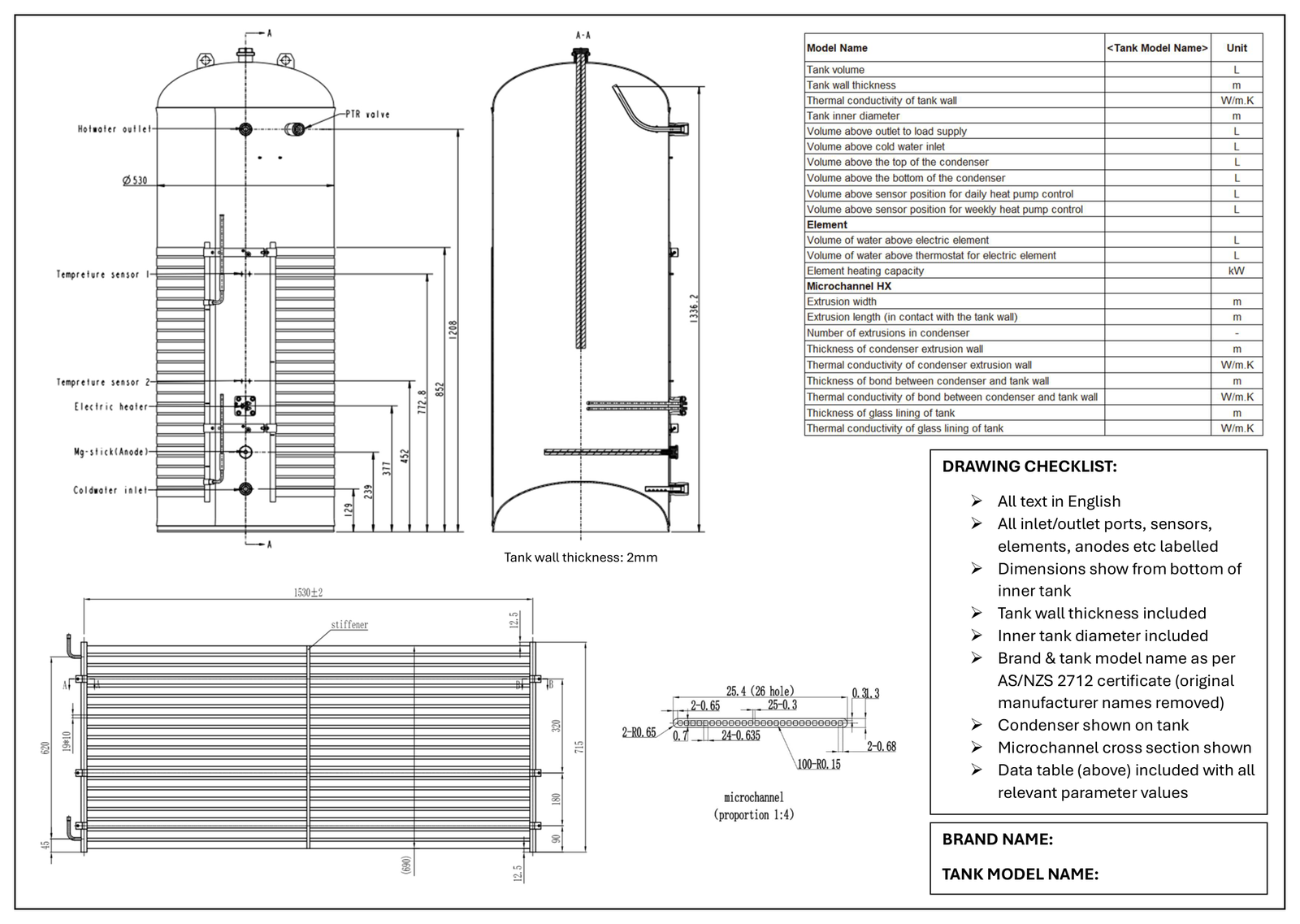
An example tank drawing is a dimensioned engineering drawing, not a brochure render. It shows the tank model name and internal volume, the internal diameter, internal height, and wall thickness, the insulation type and thickness, and the height above the tank base of every inlet, outlet, cold feed, hot draw, element boss, thermostat pocket, temperature sensor, and heat exchanger connection. A parameter table beside the drawing that lists these values is the format that maps directly into the model. The example below is an integral tank with a microchannel condenser, and it includes the parameter table and a drawing checklist.
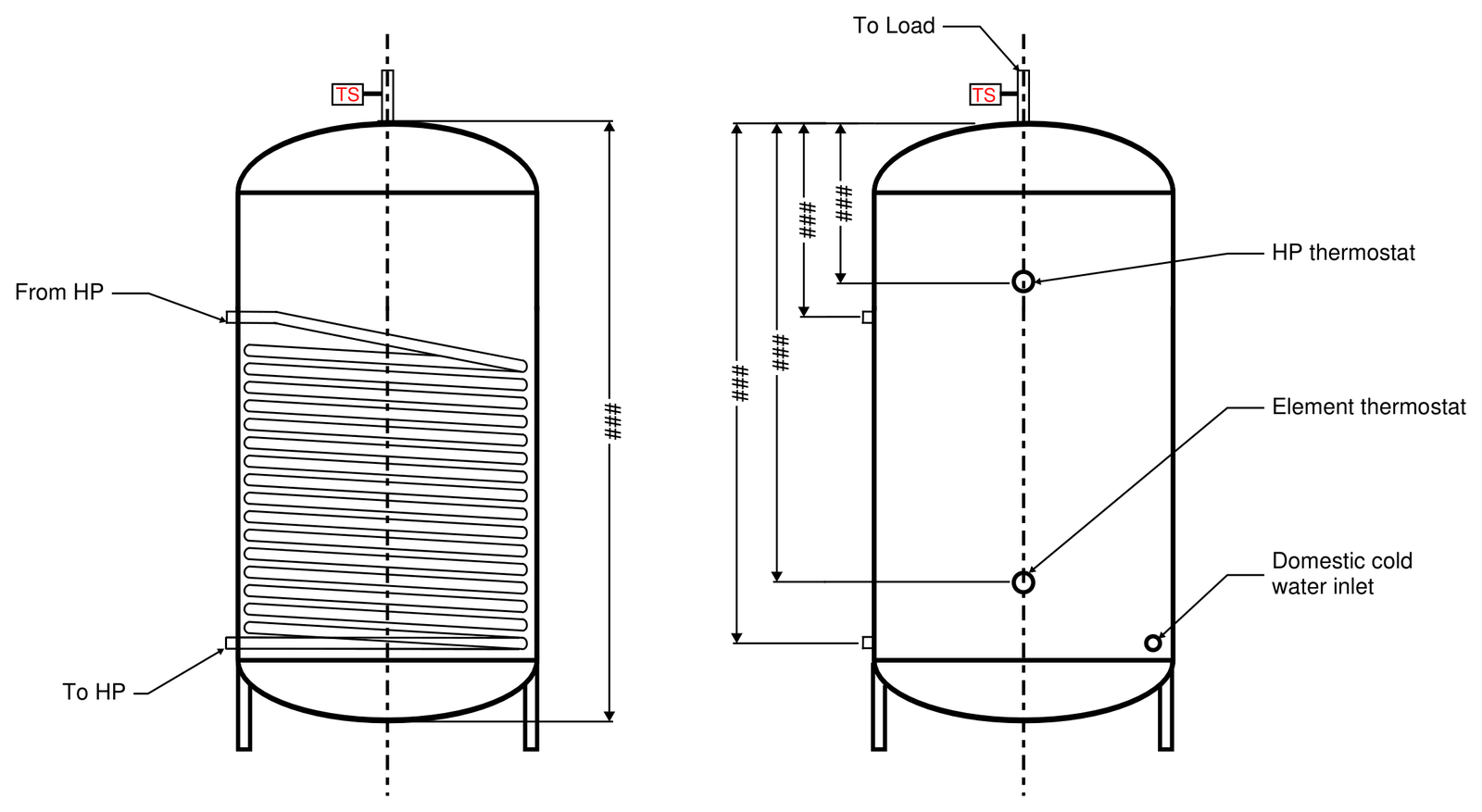
The condenser detail depends on the condenser type. For an internal coil, the drawing shows the coil inside the tank with the from-heat-pump and to-heat-pump connections, the tube run, and the sensor and element positions.
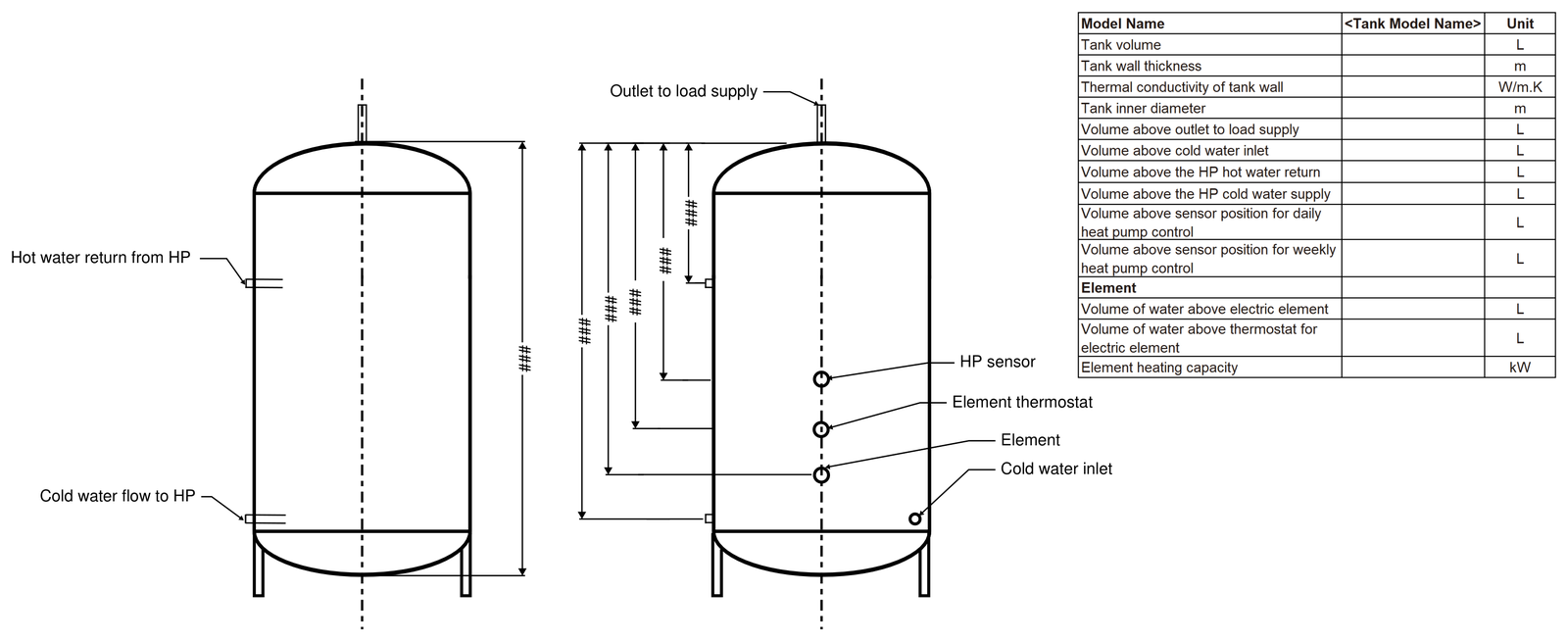
For a separate system, the drawing shows the external heat exchanger arrangement, the cold water flow to the heat pump and hot water return, the element and sensor positions, and the parameter table for the tank.
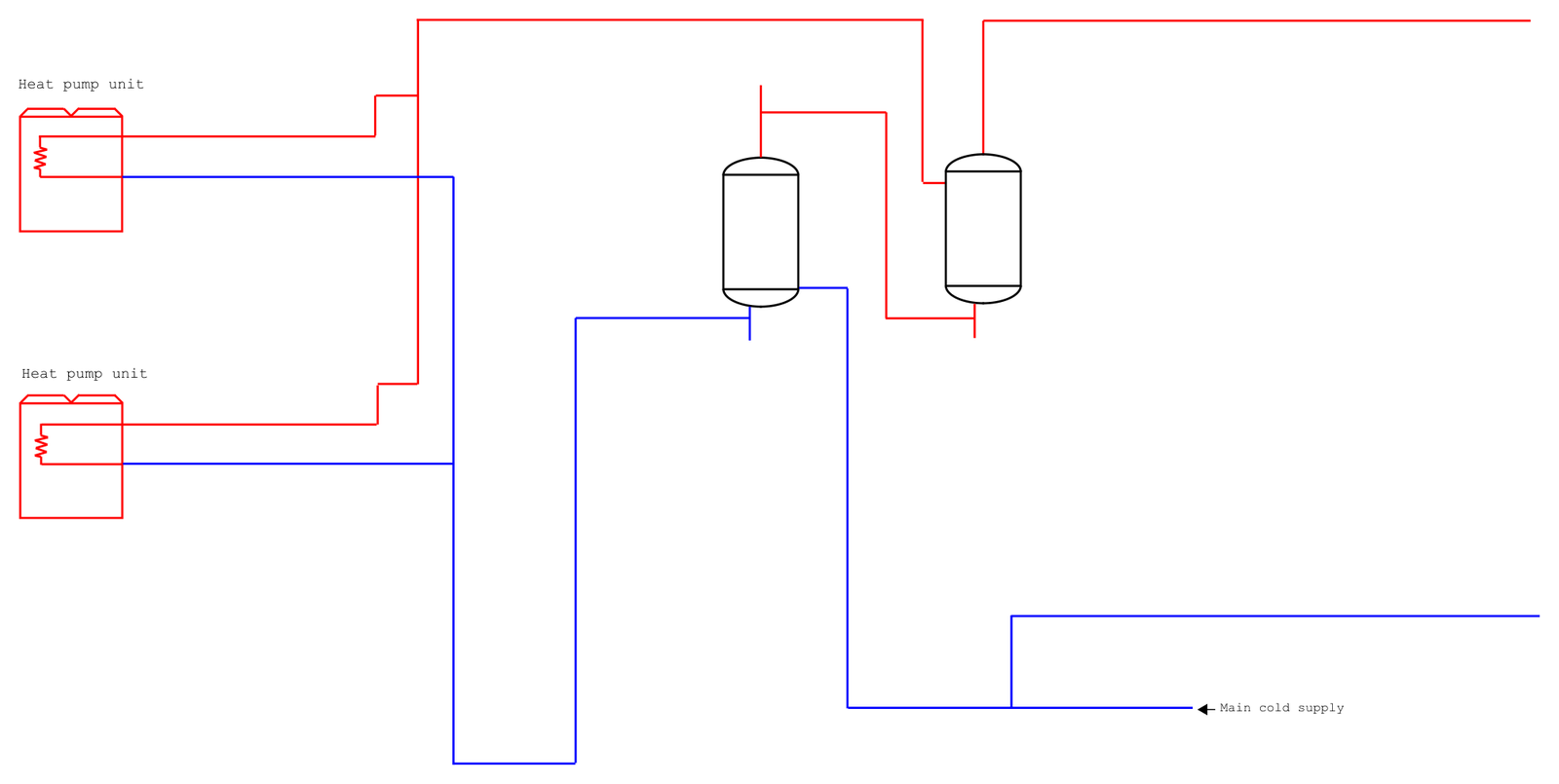
An example schematic shows the specific system being submitted with every component labelled: heat pump units, tanks, condenser or heat exchanger, flow direction, and the main cold supply. For a separate system it shows the full water circuit between the heat pump and the storage tank.
EnergyAE can also provide these example drawing templates as editable files. Get in touch if you would like them.
Control information required
EnergyAE needs the control behaviour that will apply to the product being sold, not a generic description.
Provide the default operating mode, heat pump setpoint, heat pump deadband, sensor used for heat pump control, legionella control temperature and frequency, and any conditions that disable or limit heat pump operation.
If the product has electric boost, provide the boost setpoint, deadband, element capacity, thermostat location, and control priority between heat pump and element. For separate systems, also provide the pump flow rate or flow control method, plus any factory settings that cannot be changed by the installer.
If users can change operating modes, confirm which mode is the default after installation and whether the controller automatically returns to that mode. The manual, control declaration, and modelling inputs should all describe the same behaviour.
Modelling reflects the product as it will operate in the default factory configuration, not a mode a user might trigger temporarily. Where users can permanently switch to a different mode, the default used for modelling should be the mode most likely to be set at final installation. A configuration that would not deliver sufficient hot water to a typical end user is not an acceptable basis for scheme modelling.
Certification and model identification
The AS/NZS 2712 certificate schedule should list the submitted system models. The model names should match the application, manual, data plates, tank drawing, schematic, and AS/NZS 4234 report.
For integral systems, the system model, heat pump model, and tank model are often the same name. Where they differ, the relationship needs to be clear in the certificate schedule, drawings, data plates, or manufacturer declaration.
For separate systems, different model names may exist for the heat pump, tank, and complete system. This can be acceptable, but the evidence pack needs to show which heat pump and tank combinations are covered by each submitted system model.
Electrical safety evidence should include the certificate of conformity and the relevant EESS or RCM registration evidence. Where the product is sold by an Australian or New Zealand importer under a local brand, confirm that the certificate holder, brand name, model name, and applicant entity are aligned before submission.
Manuals, data plates, and declarations
The installation manual should include the market brand and model names, plumbing arrangement, control settings, warranty terms, installer requirements, and any operating limits that affect normal use.
Data plate images should be clear enough to read the model name, serial number format, electrical ratings, refrigerant type, refrigerant charge, tank capacity, and certification marks. If the submitted product uses a local brand but the data plate or test report uses an OEM model name, prepare the supporting authorisation letter or model equivalence declaration before submission.
Manufacturer declarations are commonly needed when model names differ between documents, testing was conducted on a prototype, certificate schedules use a family name, or the application relies on test evidence from a related model.
Warranty requirements
VEU and ESS now require a warranty on the product, and the evidence must be in the pack. SRES does not impose a scheme warranty condition, but the Australian Consumer Law still applies to the sale. Because every residential HPWH sits under the 700 L storage limit these schemes use, the warranty requirement applies across the whole residential range.
For VEU, from 31 March 2025 every product installed under the residential water heating activities, Activity 1D replacing electric and Activity 3C replacing gas, must carry a warranty against defects of at least five years from the date of installation, purchase, or supply. The consumer must be given a copy of that warranty. The Essential Services Commission sets this requirement and applies it to products with insulated storage of 700 L or less.
For ESS, from 1 December 2025 water heaters with insulated storage of 700 L or less must carry a minimum defect warranty of five years, and the warranty must give an Australian contact to use if the product fails. IPART administers this through the HEER product acceptance pathway and requires the warranty to comply with Australian Consumer Law.
The warranty content can sit inside the installation or owner manual. A standalone warranty document is not required, but the warranty text must contain all of the following:
- A minimum five-year term, stated from installation, purchase, or supply.
- Australian contact details for warranty claims: a name, business address, phone number, and email.
- What the consumer must do to make a claim, and who bears the cost of claiming.
- For any product with a tank of 700 L or less, the mandatory Australian Consumer Law paragraph, reproduced word for word as its own standalone paragraph.
The Australian Consumer Law paragraph must appear unaltered:
Our goods come with guarantees that cannot be excluded under the Australian Consumer Law. You are entitled to a replacement or refund for a major failure and compensation for any other reasonably foreseeable loss or damage. You are also entitled to have the goods repaired or replaced if the goods fail to be of acceptable quality and the failure does not amount to a major failure.
EnergyAE checks the warranty as part of the VEU and ESS pack. A missing or non-compliant warranty holds up submission, so confirm the five-year term, the Australian contact, and the Consumer Law paragraph before the pack is assembled.
Scheme portal accounts and access
Modelling and documents are only half the job. Each scheme is lodged through its own online portal, and the account behind that portal has to exist and be set up correctly before a submission can go in. Create these accounts at the start of the project, because account creation and identity checks take time and are a common cause of last-minute delay.
Create the portal accounts for the schemes you are targeting. SRES (STCs) is lodged through the CER portal, VEU (VEECs) through the VEU Registry run by the Essential Services Commission, and ESS (ESCs) through IPART’s TESSA portal. Each account is set up under your own legal entity as the applicant.
Appoint an authorised signatory. TESSA requires a named authorised signatory on the account, and the ESS declarations are completed and signed digitally in TESSA by that person. CER submissions require the authorised signatory’s personal details, including date of birth, so confirm who that person is early and have their details ready.
Add EnergyAE as a secondary user where we submit on your behalf. For VEU and TESSA, EnergyAE lodges the application from inside your portal account, so you add us as a secondary user using a dedicated email alias we provide, in the form name+yourbrand@energyae.com. The alias is unique to your account and forwards to our team. Once you have added it, we test the login from our side before submission week. VEU Registry logins use the Salesforce Authenticator app for verification.
The step-by-step lodgement process for each portal is covered in the VEU Registry submission guide and the TESSA submission guide.
Common issues
Common document issues include model names that differ between the test report and certificate, manuals that show an OEM model name rather than the Australian or New Zealand market model name, and tank drawings that do not show sensor or fitting heights.
Other frequent problems are blurry data plate images, control settings in the manual that do not match the control declaration, missing raw test data, certificate schedules that do not list every model variant, and drawings that omit condenser dimensions.
For separate systems, missing pump flow evidence and unclear pipework can delay modelling. For integral systems, missing wrap-around coil or microchannel details can delay modelling because the tank heat transfer arrangement is not defined.
What EnergyAE needs from you
Send the latest PDF reports, certificate schedules, drawings, manuals, data plate images, technical details sheet, and declarations for the product as it will be sold.
If testing has not started, confirm the target schemes before locking in test scope. A test program that supports one pathway may still leave evidence gaps for another.
Get in touch with EnergyAE if you need help navigating the documentation requirements for your HPWH registration.