
1 September 2026 — Alastair McDowell
NewsletterAir-to-Water Heat Pumps Save More Energy, Not Less, in Colder Climates
This article was sent to EnergyAE newsletter subscribers on 1 September 2026. Subscribe to get the next one.
Do heat pumps work well in cold climates? Canberra, Hobart, Dunedin, Queenstown.
The question is valid. When ambient air temperature falls, the COP of an air-source heat pump falls with it.
Run times are longer in winter, but winter is also the season where a heat pump saves the most energy against electric resistance or instantaneous gas. Cold locations save the same or more over a year as warm ones, because while cold air does cost some COP, the water coming into the tank is colder as well.
The concern probably comes from space heating. A space heating heat pump does strain to heat a house when the air is cold, and the effect is obvious to whoever is sitting in the room. But heat pump water heaters are different.
COP and the size of the load
Efficiency is only half the equation. The other half is the size of the load, and in winter that load is larger because mains water is colder.
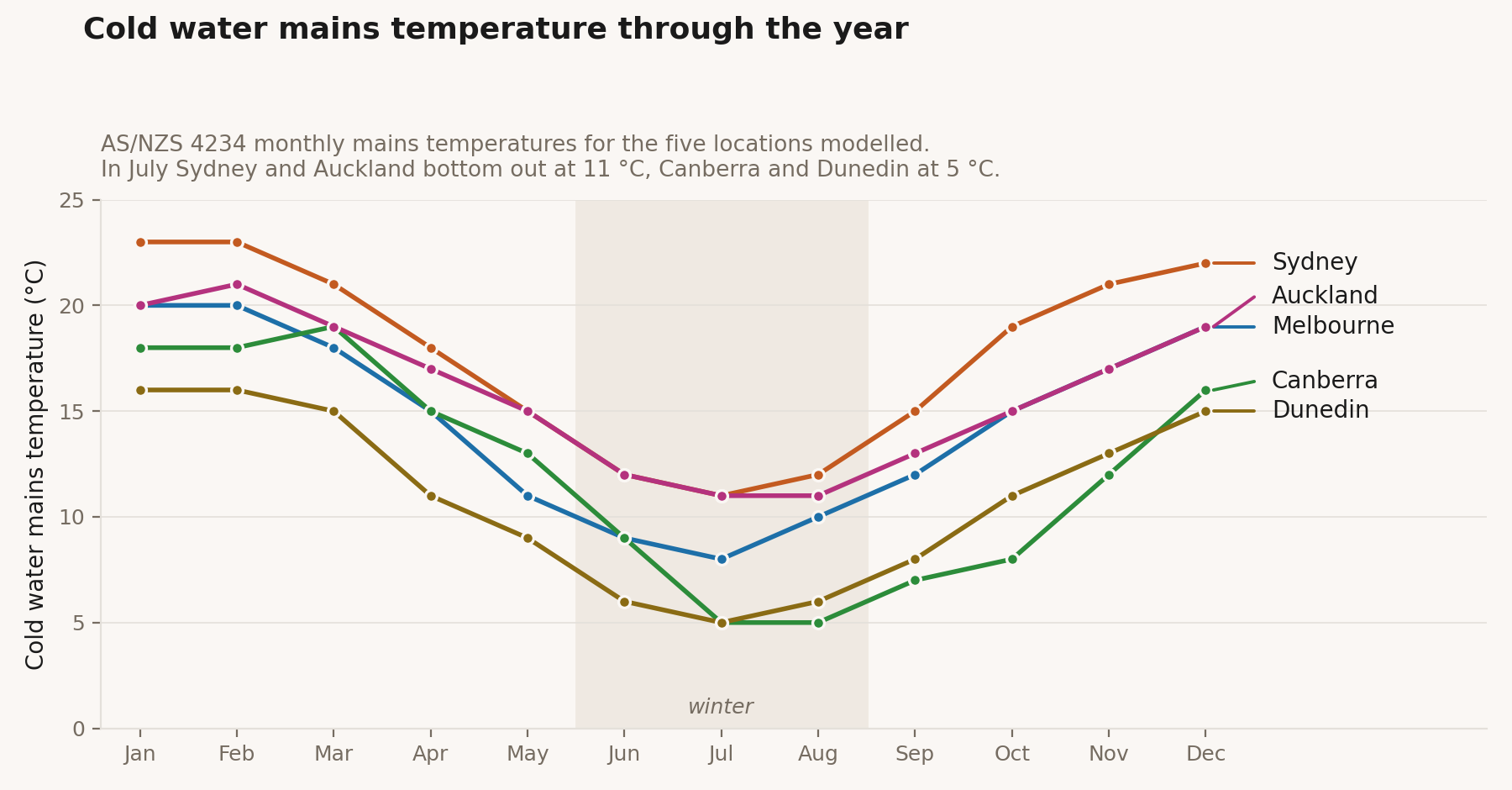
Mains water sits near 5 °C in a Canberra or Dunedin mid-winter against 16 to 23 °C in mid-summer, so every shower takes a good deal more energy to heat. That extra energy has to come from somewhere. An electric cylinder buys all of it at full price and a heat pump buys it at about a third, thanks to its COP, so the bigger the winter load gets, the more the heat pump saves.
Canberra, January against July
Canberra is the hardest test of the argument. It is one of the coldest locations in Australia and the one where frosting costs the most COP.
| Canberra, 250 L CO2 split | January | July |
|---|---|---|
| Hot water delivered | 253 kWh | 362 kWh |
| Heat pump COP | 3.9 | 3.2 |
| Electric cylinder uses | 311 kWh | 440 kWh |
| Heat pump uses | 76 kWh | 133 kWh |
| Saved that month | 234 kWh | 308 kWh |
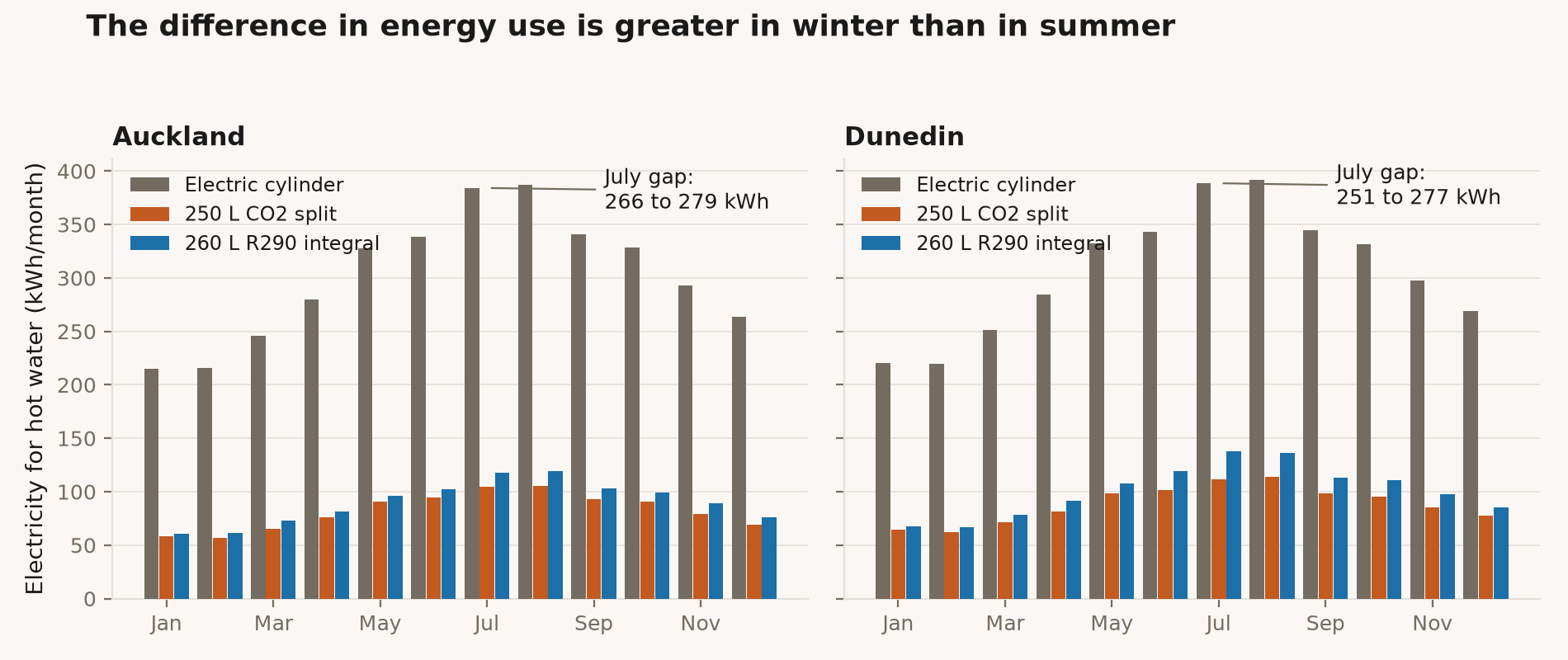
Demand up 43%, COP down 19%, saving up 31%. July is the worst month of the year for efficiency in Canberra and one of the two best for savings. Every location we ran peaks in July or August, and both product types behave the same way.
Annual savings by location
The same logic carries between climates as well as between seasons. Across three Australian cities, the cold ones come out in front. Warmer Sydney saves 3,220 kWh a year, while colder Melbourne (3,486) and Canberra (3,464) save roughly 8% more.
In New Zealand, Auckland and Dunedin land within 1% of each other. Auckland’s warmer air is offset against its warmer mains, so the two effects cancel out. Colder does not mean worse. For New Zealand it means the same.
Watch which number you quote. The percentage saving does slip as the climate gets colder, from 76% in Sydney down to 74% in Canberra, and that is the figure most people reach for. The kilowatt hours move the other way, and the kilowatt hours are what the customer pays for.
Winter recovery time
Recovery time is the real winter cost, and it is largely manageable. Heating a fully drawn tank back up from mains temperature takes the generic CO2 unit we looked at about 2.8 hours in February and about 3.8 hours in July, so winter requires running roughly a third longer. The integral unit we tested, with its smaller compressor, goes from about 4.8 hours in summer up to about 7.4 hours in winter.
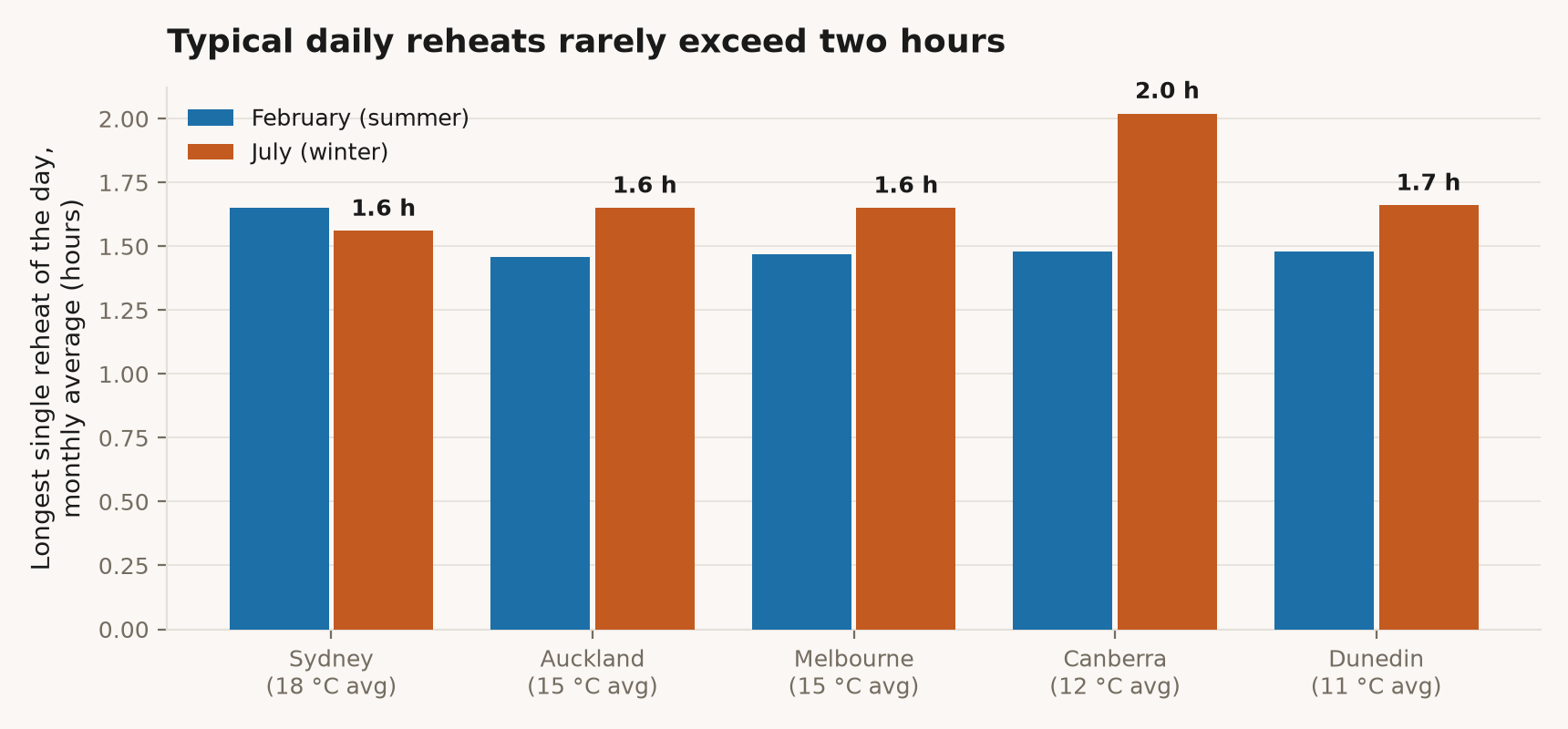
That is the worst case of a fully drawn tank. Typical reheats stay under two hours all year round, in every location we modelled.
In frost-prone areas like Canberra or Queenstown, air temperature can occasionally fall below the heat pump’s minimum operating temperature of around -7 °C. The unit then either waits for warmer air or lets the backup element take the load. A rare hour at COP = 1 on the element is not the end of the world.
The storage tank
Storage is the second reason water heating behaves differently from space heating. Water heating does not have to coincide with the time of use, because the tank stores the result. As long as the water heater can recover between the normal morning and evening peak loads, the user never runs out of hot water and the longer run times are a moot point.
Space heating has no such buffer. Run a heat pump at 8pm on a cold night into a cold room and you will be reaching for a down jacket and beanie long before the room is warm.
What this means for product claims
The cold-climate question is not really whether the COP holds up. It is whether the total saving holds up, and whether the system is sized to recover enough hot water between peak loads.
Myths like “heat pump water heaters don’t work in winter” turn away customers who would have been well served by the product. EnergyAE builds custom calculators for manufacturer websites, using your own performance data, that show energy savings across seasons, climates and household sizes. Get in touch if you want one for your range.