
23 October 2026 — Alastair McDowell
MEPS workshop for heat pump water heaters: the slides
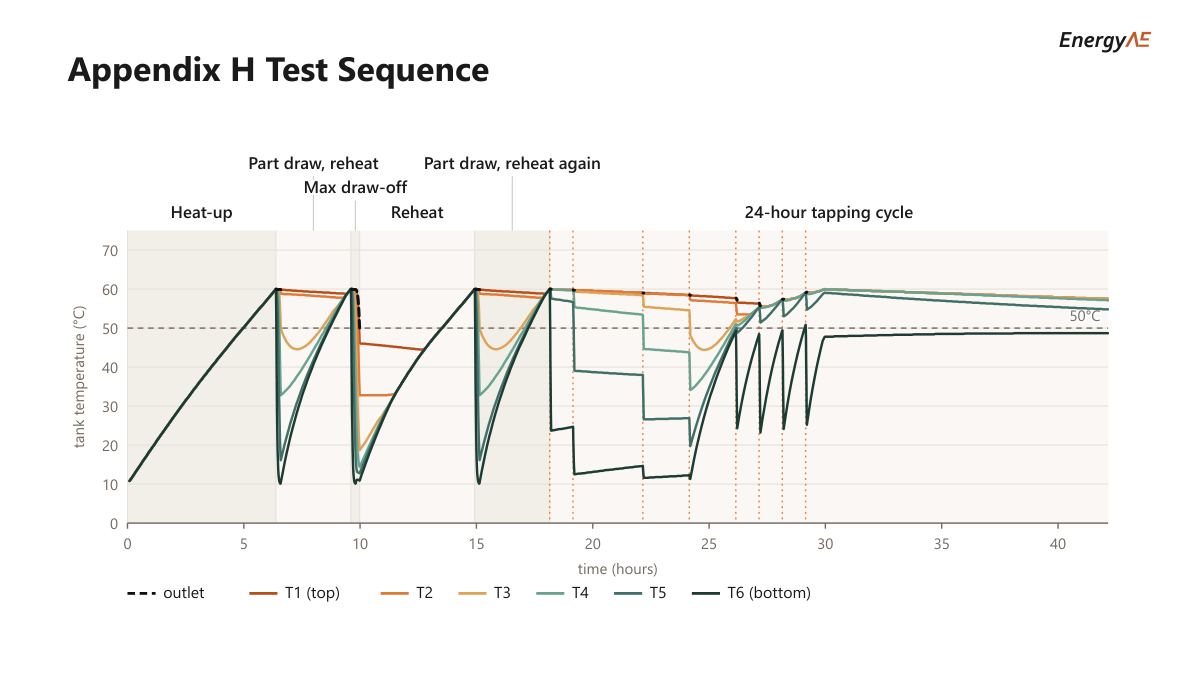
On 22 October 2026 I ran a free online workshop on the new minimum energy performance standards (MEPS) for heat pump water heaters in Australia. Thank you to everyone who joined and asked questions. The full slide deck is at the end of this page, and the interactive slides work in the page: step through the Appendix H test one stage at a time, press play on the test player, and move the sliders on the design trade-offs slide.
What the session covered
The workshop worked through the GEMS (Heat Pump Water Heaters) Determination 2026 exposure draft and the AS/NZS 5125.1 Appendix H test it calls up. It covered the timeline to commencement and the six-month grandfathering window, which products are in scope and the three product classes, and how the Appendix H sequence produces V50, recharge time and the daily COP.
It then looked at the Table 15 cap on declared load size and the difference between the 45°C minimum delivery temperature (MDT) used in scheme modelling and the 50°C figure inside Appendix H. That second point is covered in more depth in The 50°C delivery requirement in MEPS testing. The last part covered families of models, registering stand-alone systems, and labs, time and cost.
Everything in the deck is based on the exposure draft, which can still change before the determination is made. The exposure draft, its guidance document and explanatory statement are published on the Department of Climate Change, Energy, the Environment and Water consultation page. The test sequence chart, the test player and the design trade-offs tool are my simulations of the Appendix H method. They have not been checked against laboratory results.
Does the test lab need to be accredited?
This came up in the Q&A and I said I would check. As the exposure draft stands, GEMS does not require registration testing to be done by a NATA-accredited lab or an international equivalent. The draft determination does not say who must do the test. The department’s guidance document for the exposure draft says it directly: the determination does not mandate NATA accreditation, and the GEMS Act requires only that registered test results can be replicated or surpassed during compliance testing. The registrant decides whether it is confident in the results from the lab it uses.
Check testing works differently. The GEMS Regulator only authorises check tests by a person accredited for that test by NATA, or by a body that has signed the APAC or ILAC mutual recognition arrangement. That rule sits in the GEMS (Authorisation Requirements for Testing GEMS Products) Instrument 2021, made under section 125 of the GEMS Act. A registered result therefore has to hold up when an accredited lab repeats the test.
I found nothing that expressly allows or rules out in-house testing for registration. A certification body for AS/NZS 2712 sets its own rules for the test reports it accepts, and at least one has told me it expects reports from labs that are signatories to the ILAC arrangement. And one accredited Appendix H report can serve registration, certification and scheme review together.
The slides
If you would like your own product run through the Appendix H test before you book a lab, EnergyAE’s MEPS simulation service does that, and I am happy to talk it through.